

Ukraine’s “Executed Renaissance”

By Sara Thompson
Introduction
Between the end of the First World War and the Great Purge of the mid-1930s, there emerged in Ukraine a loose association of modernist novelists, playwrights, and poets who have, by more recent critics, been termed the “Executed Renaissance.” The men and women who comprised this cohort were artistically diverse, their works spanning contemporary artistic movements from futurism to neoclassicism to symbolism. Through these works they sought to participate in the construction of a new and revolutionary Ukrainian identity. Their art would not only represent Ukraine to the world but also to Ukrainians themselves.
The boldness of this vision brought them into conflict with the soviet* government in moscow, who viewed their work as nationalistic and reactionary in nature. To stifle the emergence of both political and artistic separatism within the Ukrainian SSR, soviet authorities and their Ukrainian allies subjected the young artists of the country to a campaign of censorship, intimidation, and persecution, which resulted not only in their own destruction but in the destruction of a nascent renaissance of Ukrainian artistic life. In the following decades, Ukrainian artists-in-exile would term this group of persecuted artists the “Executed Renaissance” as a means of defining the cohort of avant-garde artists active in Ukraine during the interwar period who ultimately fell victim to the political repressions of the soviet government. Their story is a bittersweet one, as are most stories which are concerned with not just what was, but what could have been.
On May 13th, 1933, Ukrainian author and activist Mykola Khvylovy invited a group of his friends to his apartment in Kharkiv. Khvylovy, born Mykola Hryhorovych Fitiliov in 1893, was at the time one of Ukraine’s most prominent poets and novelists and was politically involved in the Ukrainian “National Communist” movement, a faction of Ukrainian socialist activists who sought the recognition and preservation of Ukrainian national identity within the recently-established union of soviet socialist republics. The friends he had invited to his apartment were connected to both his political and artistic activities. It was not a happy meeting. The previous evening, Mykhailo Yalovy, a futurist poet, playwright, and close associate of Khvylovy, had been arrested by agents of the soviet secret police on the charge of counter-revolutionary activities [1]. It was the latest in a series of increasingly severe repressions the Ukrainian National Communists had experienced.

Figure 1: Ukrainian author Mykola Khvylovy, circa 1933.
With the guests assembled in his apartment, Khvylovy slipped into a neighboring room and shot himself. It was reported at the time that there were two notes found with Khvylovy as he died; the first related to his literary estate, the second expressing his political motivations for his suicide. In the second note, Khvylovy wrote:
“Arrest of Yalovy— this is the murder of an entire generation. For what? Because we were the most sincere Communists? I don’t understand. The responsibility for the actions of Yalovy’s generation lies with me, Khvylovy. Today is a beautiful sunny day. I love life— you can’t even imagine how much.” [1].
To understand why Khvylovy did what he did— to understand why a man who loved life chose to end his own— we must go back and look at the escalating repressions Ukrainian artists and intellectuals faced from moscow in the weeks, months, and years leading up to Khvylovy’s suicide. The death of Mykola Khvylovy was a personal tragedy through which greater tragedies experienced by the Ukrainian intelligentsia to which he belonged may be explored.
The Ukrainian-soviet war: 1917-1921
In June 1917, the Central Council of Ukraine, a body of activists, workers, and peasants who had come to power following the February Revolution, declared that Ukraine would remain an autonomous, semi-independent region within russia. The short-lived russian Provisional Government, led by Alexander Kerensky, recognized the resulting Ukrainian People’s Republic. However, following the October Revolution, which brought the bolsheviks (russian communists, organized under vladimir lenin) to power and established the union of soviet socialist republics, the Ukrainian People’s Republic of soviets, a rival bolshevik-aligned political faction, was established in Kharkiv [2].
Street fighting between pro and anti-bolshevik activists broke out in Kyiv, where the Central Council was located. By the end of 1917, Ukrainian political factions backed by the bolsheviks had attempted coups in Kyiv, Odesa, and Vinnytsia, which the Council successfully repressed [3]. On December 17th, 1917, the russian-based Council of People’s Commissars sent a message to the Central Council, warning them that if they did not cease their “anti-revolutionary” activities, they would launch an invasion of Ukraine. The Central Council put forward its own conditions, the recognition of Ukrainian autonomy and the participation of Ukrainian national representatives in peace negotiations with the Central Powers being chief among them. Rejecting these conditions, the Council of People’s Commissars amassed troops along the Russo-Ukrainian border, and on January 22nd 1918, the Central Council declared total independence from the ussr, sparking the Ukrainian-soviet War [3].
Although the war would result in a soviet victory in 1921 and the establishment of the Ukrainian soviet Socialist Republic, a constituent republic of the ussr, the inability for moscow-based bolsheviks to successfully suppress Ukrainian nationalist politics through any method short of military intervention demonstrated how widespread the desire for independence was among both the Ukrainian proletariat and intelligentsia during that time. The establishment of the Ukrainian SSR had been achieved through bitter conflict and the imposition of a political system upon a people who had not voted for it; the question of the extent to which Ukrainian nationalism remained a significant part of Ukrainian identity continued to trouble politicians in moscow. The bolsheviks had presented their movement as one of internationalism, and the continued presence of any nationalist sentiment could be construed as inherently subversive and antagonistic towards the ussr as a whole [4].
No member of the Ukrainian literary scene was left untouched by the war. The poet Maksym Rylsky was forced from his home by bolshevik sympathizers; writer Mykola Kulish was imprisoned, as was writer Hryhorii Kosynka. Though the artists and writers who would later constitute the Ukrainian Renaissance —also called the “Executed Renaissance—” were of diverse origins and political stances, all were shaped profoundly by the conflict that engulfed their country and by the establishment of a bolshevik government that acted as an extension of the soviet government in moscow. Driven by a desire to “conquer” the formerly-Central Council-run Kharkiv, Mykola Khvylovy moved to the city in 1921, where he married, adopted a daughter, and began to connect with other radically-minded young artists [5].
“Superfluous people”
The devastation of the First World War, the russian Revolution(s), and the Ukrainian-soviet war also had profound effects upon both local and global artistic movements in the early 1920s. An entire generation of young men had been slaughtered, entire landscapes devastated, in a pointless cataclysm of violence. Those young adults who had survived these wars were often, rather understandably, disillusioned with traditional structures of power and social values which they felt had led to the destruction of their societies. The arts flourished with movements which sought to fill this spiritual void with new systems— modernism, futurism, expressionism, surrealism, dada, etc. The emergent political movements of the time were equally radical, and often intertwined with avant garde art and literature. In this way, one might be both a socialist and a surrealist, or a futurist and a fascist, and while the Ukrainian Renaissance had a uniquely Ukrainian character, those artists comprising it worked in dialogue with global artistic and political movements.
All of the artists working in the Ukrainian SSR had to comply with the general parameters set by the government and enforced by the soviet secret police. There was no free press, even before Stalinism developed into the all-encompassing system of totalitarianism that it would ultimately become. When Mykhailo Yalovy, Mykola Khvylovy, and Mykola Kulish became the founding leaders of the literary union VAPLITE (Vilna Akademia Proletarskoi Literatury) in 1926, they did so as socialists who accepted the ideological requirements of the Communist Party.
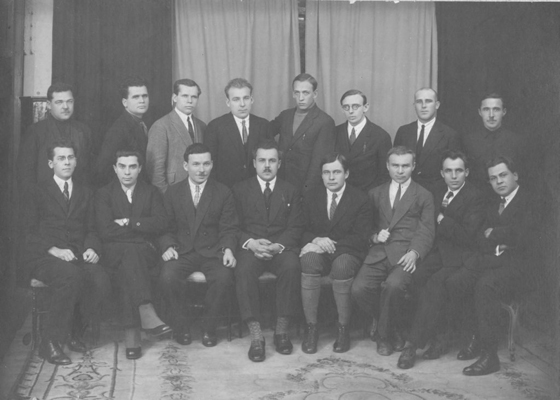
Figure 2: VAPLITE, Kharkiv, 1926.
Acceptance of the ussr’s official line, however sincere or insincere, did not inherently translate to artistic acceptance of russian norms. Khvylovy was particularly critical of russian artistic and literary achievements, stating that the great russian novels of the previous century were crammed full of “superfluous people,” and tinged with too much pessimism to be suitable models for Ukrainian authors [5].
These artistic criticisms carried with them an implicit political criticism; that Ukrainian artistic independence reflected deeper differences between Ukrainians and russians that could be used to justify political independence. The same year that Khvylovy helped found VAPLITE, joseph stalin wrote,
“At a time when the proletarians of Western Europe and their Communist Parties are in sympathy with “moscow”, this citadel of the international revolutionary movement and of leninism, at a time when the proletarians of Western Europe look with admiration at the flag that flies over moscow, the Ukrainian Communist Khvilevoy has nothing better to say in favor of ‘moscow’ than to call on the Ukrainian leaders to get away from ‘moscow’ ‘as fast as possible’. And that is called internationalism! What is to be said of other Ukrainian intellectuals, those of the non-communist camp, if communists begin to talk, and not only to talk but even to write in our soviet press, in the language of Khvylovy?” [5]
The admission (under duress) of political error by Khvylovy and other members of VAPLITE in December of 1926 and the removal of Khvylovy, Yalovy, and author Oles Dosvitnii from the union in January of 1927 were not enough to preserve the organization. A VAPLITE-published work which drew particular ire was Khvylovy’s incomplete 1927 novel Val’dshnepy (“Woodcocks”), which satirized the political tensions between Ukraine and russia [6]. (The title may be a reference to how easily the woodcock is captured, a metaphor for how foolish, self-centered people are easily swayed by propaganda). The first half of the novel was published in the VAPLITE magazine in early 1927; the second half was confiscated by authorities and destroyed before its publication [6]. This abortive attempt at concluding Val’dshnepy represented VAPLITE’s final attempt at publishing a magazine; VAPLITE was forced to dissolve itself in 1928 [7].
The trap tightens
Following the dissolution of VAPLITE, its members re-organized into several new organizations and publications; the first of these was Literaturnyi, a journal edited by Khvylovy which published several satirical works he had penned, as well as plays by Mykola Kulish, the novel Chorne ozero (“The Black Lake”) by Volodymyr Gzhytsky, and poetry and prose by Ivan Senchenko, Volodymyr Sosiura, Vasyl Mysyk, Oleksa Vlyzko, and Maik Yohansen, among others. The journal retained VAPLITE’s orientation towards western European literary movements and away from political/artistic union with russia. It ran for only two years before it was forcibly liquidated by authorities in February 1930 [5].
From March to April of 1930, the Kharkiv Opera Theater was home to the show-trial of forty-five Ukrainian intellectuals. The defendants were charged with “counter-revolutionary” activity connected to their supposed involvement in the Union for the Liberation of Ukraine (Soiuz vyzvolennia Ukrainy, or SVU), a purported underground political organization which, soviet prosecutors claimed, sought the establishment of an independent Ukrainian Republic [8]. Despite the lack of evidence that such an organization actually existed, forced confessions sealed the defendants’ fate. The real target of the trial was not the SVU as an organization, but the cultural elites of Ukraine. According to one of the trial’s defendants, interrogator Solomon Bruk repeatedly stated, “We need to bring the Ukrainian intelligentsia to its knees. This is our task, and it will be done. Shoot those who do not deliver!” [9]. All of the defendants were convicted and sentenced to at least three years in prison. Some were ultimately exiled from Ukraine, while others perished within the Gulag system. It is difficult to estimate the full scope of arrests related to the trial, but as many as 30,000 artists and scientists may have suffered arbitrary detention, exile, and/or execution in connection to this purge [10].

Figure 3: Union for the Freedom of Ukraine trial, Kharkiv, 1930.
Back in 1927, when VAPLITE came under intense soviet scrutiny for its perceived nationalist tendencies, a rival organization of Ukrainian writers was established to represent pro-soviet, pro-russian authors and artists. This group, the All-Ukrainian Association of Proletarian Writers (Vseukrainska spilka proletarskykh pysmennykiv or VUSPP) sought recognition from the Communist Party, and exerted considerable effort to denounce the former members of VAPLITE and other disfavored groups in an attempt to solidify itself as the officially-sanctioned literary union within Ukraine. After the breakup of Literaturnyi, its members again re-formed as Prolitfront, an entity which lasted less than a year before it was pressured to dissolve by the VUSPP, despite Prolitfront’s concessions to the VUSPP’s ideology and Khvylovy’s pivot to socialist realism [1]. It seemed that Khvylovy, VAPLITE, and the members of Ukraine’s Neoclassicist movement of the 1920s (which favored aesthetic, rather than propagandistic, content) had become backed into a corner, from which they could extend no part of themselves that would not be swatted down by the VUSPP, the Ukrainian SSR, or the ussr itself. In 1928, Khvylovy wrote a letter to his friend Yalovy where he complained, “What do they want from us? To lick their butts? If there was no Val’dshnepy, they would have found something else to accuse me of.” [5].
Mykola Kulish was forbidden from joining the VUSPP after the dissolution of Prolitfront, effectively boxing him out of Ukraine’s public-facing literary community. Yurii Yanovsky’s 1931 novel Chotyry shabli (Four Sabers) was banned shortly after its publication. Mykola Khvylovy, suffering from tuberculosis, attempted to write stories which adhered to the party line, but the short stories he published in the early 1930s failed to gain any critical attention. The “Slovo” house in Kharkiv where many of the former VAPLITE members lived was placed under constant government surveillance [11]. Then, in the midst of these personal crises, a famine plunged the entire nation into crisis.
In 1932, the Holodomor, an artificial famine sparked by the policies of the soviet government, swept across Ukraine [12]. The origins and consequences of the Holodomor upon Ukraine would deserve an entire article in its own right, but the concise background for this event is this: that programs of collectivization and de-kulakization enforced by the ussr in Ukraine in the late 1920s and early 1930s led to the confiscation and re-organization of agricultural resources within the country [12]. The persecution of middle-class “kulak” farmers and the imposition of grain-export quotas sharply reduced the productivity of Ukrainian farmers and the amount of food available within Ukraine, causing a cascade of systemic collapses that resulted in widespread famine [12]. The soviet government not only failed to provide famine relief, but continued to export grain from Ukraine even as production rates fell throughout 1930 and 1931 [12].
By early 1933 peasants were starving on the streets of Kharkiv [13], and the overall death toll was spiking from 250,000 to several million, driven in part by orders given by joseph stalin that “grain hoarders” would be arrested, their supplies confiscated. In practice, this meant that any quantity of saved food could be seized at any time, intensifying the rate at which Ukrainians starved [12]. It was against this backdrop that Khvylovy, by then thirty-nine, traveled with his friend Arkadii Liubchenko, former secretary of VAPLITE, to the region of Poltava, to write a puff piece about conditions in the countryside. Instead, he was struck by the widespread devastation of the famine, and the ways in which the soviet administration intentionally aggravated it. Khvylovy had always viewed himself as both a Communist and as a Ukrainian; to see the destruction of Ukrainian people and culture under the banner of collectivization must have felt like a deep betrayal. What was now underway was not merely the destruction of Ukrainian political or artistic distinctiveness but the destruction of the Ukrainian people wholesale, a destruction through famine which Khvylovy stated was intended, “to provoke resistance and, after having crushed it, to settle once and for all the dangerous Ukrainian problem.”
We must return at last to Khvylovy’s apartment on May 13th, 1933. Young but sick, Khvylovy awaits the arrival of his guests. Yalovy is imprisoned; surely more arrests will follow. But even outside of prison walls there is nothing left to eat in the country. After Olesya Dosvitnyi and Mykola Kulish arrive, he tells them that he will show them, “how a proletarian author should behave” [14]. He goes into the next room, ostensibly to get a manuscript. A few moments later, a gunshot rings out.

Figure 4: Funeral of Mykola Khvylovy, May 15th, 1933.
Execution and rebirth
If Khvylovy’s suicide was driven in part by fear of another purge, then he was correct in predicting that Mykhailo Yalovy’s arrest would spark a wave of arrests of former VAPLITE members. In 1934, Oles Dosvitnii was arrested and shot. That same year, VAPLITE member Vasyl Vrazhlyvy was arrested and sentenced to death by firing squad in 1935. Oleksa Slisarenko, poet, author, and VAPLITE member, was arrested in 1934 and executed in 1937, as was Epik Hryhorii and Mykola Kulish [15]. Yalovy himself would not live to see freedom; in November of 1937 he was shot at Sandarmokh forest, and was buried there in a mass grave. He was forty-two years old [16].

Figure 5: Mykhailo Yalovy (1895-1937). Picture taken c. 1910.
Purges continued. In 1936, the head of the ussr’s secret police (the narodnyy komissariat vnutrennikh del, or nkvd), genrikh yagoda, was purged and replaced with hard-liner nikolai yezhov, under whose command the nkvd embarked upon its most intense phase of purges and repressions [17]. It was during this period that many of the previously imprisoned Ukrainian intellectuals were shot; furthermore, 233 writers were arrested during this period, of which 192 were deported, imprisoned, or executed. An additional sixteen disappeared without explanation, and eight committed suicide, hounded to death by the nkvd and its collaborators [18]. It is one thing to calculate the staggering loss of life for which Stalinism was responsible, but what is much harder to enumerate is all that work which was left unfinished— how many unwritten books died in the minds of their authors. What we are left with is merely the empty space where we know poems and novels should have been, but the finality of murder means those spaces shall remain unfilled. It was later recorded by the “Slovo” Association (a group of Ukrainian writers in exile) that in 1930 there were 259 Ukrainian authors with works in print. A mere eight years later, only 36 authors remained in print. This statistic suggests that 86.1% of pre-Holodomor, pre-Great Purge Ukrainian authors were deported, imprisoned, censored, or dead in less than a decade [18].
This destruction of an entire generation of Ukrainian creatives was only termed the “Executed Renaissance” in 1959, when Yurii Lavrinenko —a literary scholar who had been exiled from Ukraine in 1939— sought the advice of Polish author and critic Jerzy Giedroyc when picking the title for an anthology of 1910s-1930s Ukrainian literature [19]. The book, The Executed Renaissance, An Anthology, 1917–1933: Poetry, Prose, Drama and Essay (Розстріляне відродження: Антологія 1917-1933: Поезія — проза — драма — есей) was sent to the Ukrainian Writers’ Union in Kyiv, and to journals based in the Ukrainian SSR. This term, “Executed Renaissance,” gained popularity within Ukraine as a way of referring to those artists who had been purged during the interwar period. Some objected to it, arguing that it compressed the fates of authors of that time into a singularity, when in reality there were important interwar Ukrainian authors who survived, often in exile. Literary historian Yarina Tsymbal argued that a better term for this group of writers was the “Red Renaissance,” as this was a term that some within the community used to describe themselves within their own lifetimes, but “Red Renaissance” did not gain the traction that “Executed Renaissance” had and still has to this day [20].
In recent years there has been a bit of a revival of popular interest in the authors of the Executed Renaissance. Modern Ukrainians, seeking to connect with and preserve their cultural heritage in the face of invasion, have taken to the figures of the Executed Renaissance as symbols of Ukrainian resistance to external political/cultural threat. A movie about the residents of the “Slovo” building in Kharkiv (where Mykola Khvylovy lived and died) was given international release in 2024, the same year that a memoir written by Volodymyr Kulish, the son of Mykola Kulish, was published. The stories of the Executed Renaissance have never seemed more relevant, as dozens of Ukrainian intellectuals have been killed since February 2022 [21]. A musical focused upon the Slovo building was produced in 2024, in which the actors representing the slain writers wore t-shirts printed with the names of artists killed in the ongoing war [22]. That musical, “You (Romance),” took its name from a 1924 novel written by Mykola Khvylovy. In that novel, I am (Romance), (Я (Романтика)) Khvylovy wrote:
“Then, suddenly, the distance beyond the hills rises before me. Once more, painfully, I feel the desire to fall to my knees and gaze prayerfully at the burly silhouette of the Commune’s black tribunal.
Grasping my head in my hands, I keep going down the deathly road as the transport rumbles behind me.
Suddenly, I give a start: ‘What is that? Am I hallucinating? Is that really my mother’s voice?’
Again I feel such insignificance and a pain somewhere under my heart. I want to weep — not to wail but to shed a cascade of minute tears on a warm breast, as I did as a child.
A thought flashes through my mind: ‘Am I really leading her to her execution?’
What is this: reality or hallucination?
But it is indeed real — a veritable and vital reality, as savage and cruel as a pack of hungry wolves. A reality as irrevocable and imminent as death itself.
But could it be a mistake?
Maybe something else should be done?
Ah, but this is cowardice, vacillation. In life there is a certain law: errare humanum est. So, why worry? So — err! And err precisely in this, not something else! For what other mistakes can you make?”[23]
*In honor of Ukraine’s dignity and in deference to the fallen men and women fighting to protect Ukraine’s right to exist, use of lower case is intentional.
Sources:
- Layman, A. R. (2016). Mykola Khvylovy and the Ukrainian Renaissance (Doctoral dissertation).
- Ukraine: A History, Fourth Edition. University of Toronto Press. 2009. p. 353.
- Іваненко, В. (2020). The Chimera of the All-russian «Founder» and the Collapse of the Illusions of the Ukrainian Central Rada (End of 1917–Beginning of 1918). Науково-теоретичний альманах Грані, 23(1-2), 82-92.
- White, E. (2007). The Socialist Revolutionary Party, Ukraine, and russian National Identity in the 1920s. The russian Review, 66(4), 549-567.
- Palko, O. (2019). Mykola Khvyl’ovyy and the Making of soviet Ukrainian Literature. Connexe: les Espaces Postcommunistes en Question(s), 5, 29-52.
- Struk, D. H. (1968). Tupyk or Blind-Alley. “Val’dshnepy” of M. Khvyl’ovyi. Canadian-American Slavic Papers, II, 2, 239-251.
- Tytar, O. V. (2014). Ukrainian Identity of New Public Man in Philosophy Culture of M. Khvylovy. The Journal of VN Karazin Kharkiv National University. Series “Theory of Culture and Philosophy of Science”, (1142), 133-138.
- Mace, J. E. (1981). Communism and the Dilemmas of National Liberation: National Communism in soviet Ukraine, 1918-1933. University of Michigan.
- Šapoval, J. I. (2019). The “Union for the Liberation of Ukraine” (“SVU”) Trial: Fabrication, Mechanisms, Consequences. Political and Transitional Justice in Germany, Poland and the soviet Union From the 1930s to the 1950s. Wallstein Publishing. p. 36-53.
- Shkandrij, M., & Bertelsen, O. (2013). The soviet Regime’s National Operations in Ukraine, 1929–1934. Canadian Slavonic Papers, 55(3-4), 417-447.
- Kopatz, P. A. (2022). The Kharkiv Writers’ House: Ukrainian Culture and Identity in the 1920s and 1930s (Master’s thesis, The Ohio State University).
- Richardson-Smith, B. (2021). The Holodomor. Fields: Journal of Huddersfield Student Research, 7(1).
- Procyk, O., Heretz, L., & Mace, J. E. (1986). Famine in the soviet Ukraine, 1932-1933: A Memorial Exhibition, Widener Library, Harvard University. Harvard University Press.
- Komarnyckyj, S. (2023). The Hunger Games. Index on Censorship, 52(4), 116-119.
- “Hit List: The Executions of Ukrainian Writers.” Chytomo.com. December 2, 2024. https://chytomo.com/en/hit-list-the-executions-of-ukrainian-writers-sentence-executed-how-the-soviet-union-disposed-of-ukrainian-writers/.
- Kysla, I. (2018). Rethinking the Postwar Era: soviet Ukrainian Writers Under Late Stalinism, 1945-1949.
- Getty, J. A., & Naumov, O. V. (2008). Yezhov: The Rise of Stalin’s “Iron Fist”. Yale University Press.
- Юрій Лавріненко (2004). “Розстріляне відродження: Антологія 1917—1933” [Shot Revival: An Anthology 1917-1933]. Київ: Смолоскип publishers.
- Lushnycky, Andrej N.; Riabchuk, Mykola (2009). Ukraine on Its Meandering Path Between East and West. Bern: Peter Lang. p. 185.
- Troskot, I. (2016, March 3). Ярина Цимбал: “Психологічний роман передував масовим жанрам”. Litakcent.com; Litakcent. http://litakcent.com/2016/03/03/jaryna-cymbal-u-1920-h-psyholohichnyj-roman-pereduvav-masovym-zhanram/
- PEN International. (2024, March 2). Ukraine: Over 100 Cultural Figures Killed by russian Forces Since Full-Scale Invasion. PEN International; Pen International. https://www.pen-international.org/news/ukraine-over-100-cultural-figures-killed-by-russian-forces-since-full-scale-invasion
- Constant Méheut. (2024, December 4). Writers Silenced by Stalin Get New Life Amid War in Ukraine. The New York Times. https://www.nytimes.com/2024/12/04/world/europe/stalin-ukraine-writers-war.html?smid=url-share
- I am (Romance). (2021, January 3). In Wikisource. Retrieved 04:39, June 24, 2026, from https://en.wikisource.org/w/index.php?title=I_am_(romance)&oldid=10803853
Figures:
- File:MykolaHvylovyukraine.jpg. (2025, July 6). Wikimedia Commons. Retrieved June 18, 2026, from https://commons.wikimedia.org/w/index.php?title=File:MykolaHvylovyukraine.jpg&oldid=1052918641.
- File:ВАПЛІТЕ.jpg. (2025, October 6). Wikimedia Commons. Retrieved June 18, 2026, from https://commons.wikimedia.org/w/index.php?title=File:%D0%92%D0%90%D0%9F%D0%9B%D0%86%D0%A2%D0%95.jpg&oldid=1095927783.
- File:SVU trial 1930.jpg. (2025, November 15). Wikimedia Commons. Retrieved June 18, 2026, from https://commons.wikimedia.org/w/index.php?title=File:SVU_trial_1930.jpg&oldid=1116144298.
- File:Похорони Хвильового.jpg. (2026, April 14). Wikimedia Commons. Retrieved June 18, 2026, from https://commons.wikimedia.org/w/index.php?title=File:%D0%9F%D0%BE%D1%85%D0%BE%D1%80%D0%BE%D0%BD%D0%B8_%D0%A5%D0%B2%D0%B8%D0%BB%D1%8C%D0%BE%D0%B2%D0%BE%D0%B3%D0%BE.jpg&oldid=1197397468.
- File:Яловий Михайло Омелянович.jpg. (2025, July 13). Wikimedia Commons. Retrieved June 18, 2026, from https://commons.wikimedia.org/w/index.php?title=File:%D0%AF%D0%BB%D0%BE%D0%B2%D0%B8%D0%B9_%D0%9C%D0%B8%D1%85%D0%B0%D0%B9%D0%BB%D0%BE_%D0%9E%D0%BC%D0%B5%D0%BB%D1%8F%D0%BD%D0%BE%D0%B2%D0%B8%D1%87.jpg&oldid=1057077103.


